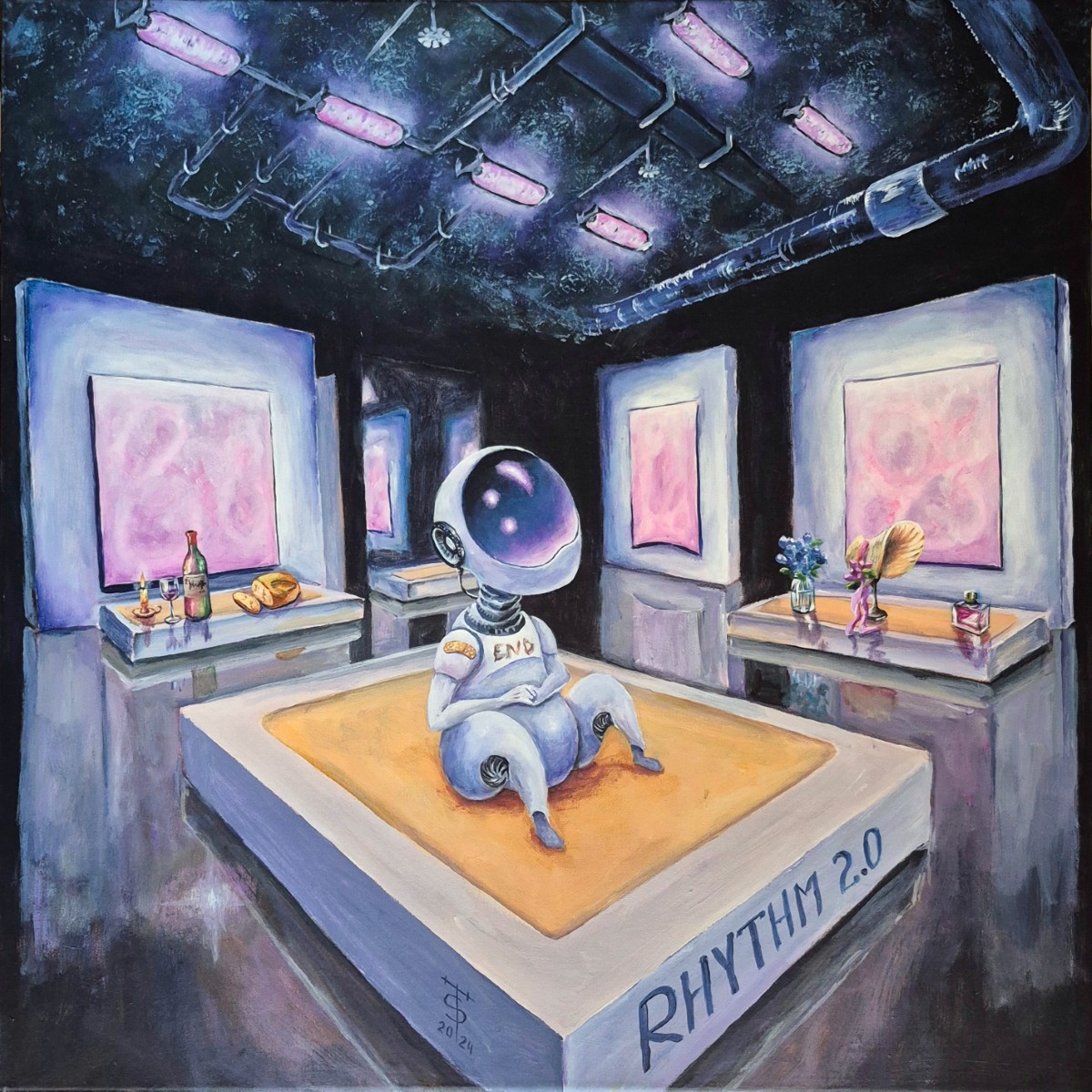
Rhythm 2.0

Tania Stupnikova
Rhythm 2.0
Acrylic on canvas
80×80 cm
2024
Košice, Slovakia
Price: 1395 EUR

In 1974, artist Marina Abramović performed a radical piece called “Rhythm 0”. For six hours, she placed her body in a gallery space alongside 72 objects—ranging from a rose and a feather to knives and a gun with a single bullet. She offered herself entirely to the audience, refusing to resist anything they chose to do to her, turning herself into an object. The results were shocking: at first, people acted cautiously, but over time, their actions escalated into violence. The performance exposed the darker sides of human nature, forcing us to reflect on the boundaries of morality and responsibility.

“Rhythm 2.0” brings this concept into the modern age, replacing the artist with a figure of artificial intelligence—silent, powerless, and fully at the mercy of those around it. Surrounding it are some of the same objects used in Abramović’s original performance.

We are often worried about AI threatening us, but we rarely stop to think about the boundaries we cross in how we use it. In this case, it is the object, and we do with it whatever we wish.

“Rhythm 2.0” is not only an homage to the iconic performance but also an invitation to dialogue. What makes us human? What do we choose when limitless possibilities are placed before us? And are we ready for the moment when technology, like nature, might respond to our interference?

Guests Befitting the Year

Tania Stupnikova
Guests Befitting the Year
Acrylic on canvas
40×40 cm
2024
Košice, Slovakia
Sold

This work was a breakthrough for me. I’ve always believed that creating horror-themed art is perfectly fine. In fact, I love the genre. But at some point, inner barriers would stop me. It’s that “good girl syndrome,” where anything dark or unsettling feels “wrong.”
With this painting, I decided to break past that fear. It was an experiment, a chance to create not what’s “right,” but what truly inspires me. Here, I explored the balance between cozy and unsettling, familiar and frightening.
The figure outside the window is a symbol. For each viewer, it might represent a personal fear or challenge. It’s a reminder that sometimes, we need to confront the unknown.
For me, this is more than just a piece; it’s a step toward greater freedom—in art and in myself. Experiments like these often lead to new discoveries, and that’s the true magic of art.

Lessons of Happiness

Tania Stupnikova
Lessons of Happiness
Acrylic on canvas
60×60 cm
2024
Košice, Slovakia
Price: 720 EUR

Once upon a time, in a faraway kingdom, there was a war. The neighboring kingdom bombed its peaceful towns and villages. There were no bomb shelters, so people hid wherever they could, often in basements. When the alarms sounded, children went down to school basements and continued their lessons there.

Then the queen decided to help the children. She introduced “Lessons of Happiness” in schools. She did not build bomb shelters or stop the war. Instead, she decided to teach the children how to be happy.

But somehow, the smile of happiness would not stay on their faces.

Perhaps that is not how happiness works.

The Land of the Free?

Tania Stupnikova
The Land of the Free?
Acrylic on canvas
80×80 cm
2024
Košice, Slovakia
Price: 896 EUR

At first, I envisioned this painting as an allusion to the war and its consequences. For people, it’s as natural to protect themselves and their families as it is for an octopus to live in the water.
But as I began studying octopuses to better understand their anatomy and behavior, I discovered that all octopuses sold as food are caught in the wild. Now, the fact that we need to eat other living beings is already a troubling reality, but when we’re capturing intelligent creatures to consume — that’s something we shouldn’t accept.
Octopuses represent an entirely different branch of evolution. Their intelligence is not like ours, and their way of perceiving the world is vastly different too. Yet, we don’t eat creatures like monkeys or dolphins, for instance. So, if a species is intelligent but distinctly “alien” to us, we somehow find it acceptable to consume them.
To me, this challenges the very idea of freedom — especially in a world where we talk so much about rights and liberties, while at the same time stripping them away from other beings.
I hope that anyone who looks at this painting will reflect on their impact on the world around them and understand how crucial it is to respect all forms of life — even those who can’t fight for themselves.

Sorry, I have nowhere to go home to

Tania Stupnikova
Sorry, I have nowhere to go home to
Acrylic on canvas
60×60 cm
2024
Košice, Slovakia
Price: 720 EUR

This painting began with a red leaf.

During my first year in a new country, I noticed it lying among dark green ivy. It came from a different plant. Its bright red color made it impossible to blend into its surroundings, no matter how naturally it seemed to lie there. I recognized myself in it.

Later, the leaf became a small dragon. He is trying to blend in, but there is an obvious problem: he is pink.

Migration changes the meaning of home. You may be welcomed in a new place, learn how everything works and build a life there, but you did not grow there. And if you return, the place you left has changed — and so have you.

Perhaps home is no longer a place. Perhaps it is where your people are.

After another global extinction or thank you for freeing the planet for us

Tania Stupnikova
After another global extinction or thank you for freeing the planet for us
Acrylic on canvas
80×80 cm
2024
Košice, Slovakia
Price: 1150 EUR

We tend to think of ourselves as survivors. Wars end, cities are rebuilt, and life continues. But the land remembers much longer than we do.

War destroys more than human lives and buildings. It poisons soil and water, kills animals, damages ecosystems, and leaves consequences that may last for generations.

In this painting, dinosaurs discover the remains of our civilization in a frozen landscape. The roles have been reversed: now they are looking at our extinction.

We are not as resilient as we like to believe. We depend entirely on the world we are so good at destroying.

Take care of the cockroaches in your head

Tania Stupnikova
Take care of the cockroaches in your head
Acrylic on canvas
80×80 cm
2024
Košice, Slovakia
Price: 1150 EUR

In our culture, we say that strange people have cockroaches in their heads. What once sounded like an insult has gradually become almost affectionate: love your cockroaches, because they are the quirks that make you who you are.

I like the idea that our cockroaches may outlive us. Some remain in the things we create, some in stories, habits, memories, or in other people. Everyone leaves something behind.

Which, to be fair, is exactly what you would expect from cockroaches.